


Parkinson’s disease (PD), or simply Parkinson’s, is a neurodegenerative disease of mainly the central nervous system that affects both the motor and non-motor .
Parkinson’s disease is an age-related degenerative brain condition, meaning it causes parts of your brain to deteriorate. It’s best known for causing slowed movements, tremors, balance problems and more.
Parkinson disease (PD) is a brain condition that causes problems with movement, mental health, sleep, pain and other health issues.
Parkinson disease results in high rates of disability and the need for care. Many people with PD also develop dementia.
The disease usually occurs in older people, but younger people can also be affected. Men are affected more often than women.
Parkinson’s disease is an age-related degenerative brain condition, meaning it causes parts of your brain to deteriorate. It’s best known for causing slowed movements, tremors, balance problems and more. Most cases happen for unknown reasons, but some are inherited. The condition isn’t curable, but there are many different treatment options.
Aradhya Clinic & Neuro Research Center (ACNRC)
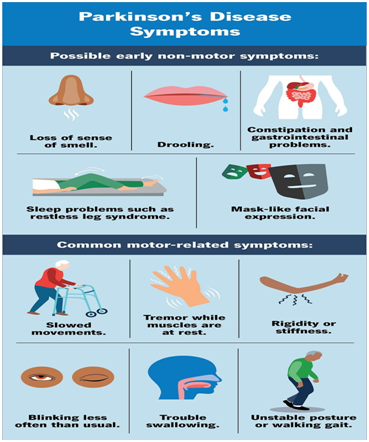
Parkinson’s disease has several common non-motor (non-movement) symptoms and motor symptoms. Non-motor symptoms sometimes appear years ahead of motor symptoms.
How does this condition affect my body?
Parkinson’s disease causes a specific area of your brain, the basal ganglia, to deteriorate. As this area deteriorates, you lose the abilities those areas once controlled. Researchers have uncovered that Parkinson’s disease causes a major shift in your brain chemistry.
Under normal circumstances, your brain uses chemicals known as neurotransmitters to control how your brain cells (neurons) communicate with each other. When you have Parkinson’s disease, you don’t have enough dopamine, one of the most important neurotransmitters.
When your brain sends activation signals that tell your muscles to move, it fine-tunes your movements using cells that require dopamine. That’s why lack of dopamine causes the slowed movements and tremors symptoms of Parkinson’s disease.
As Parkinson’s disease progresses, the symptoms expand and intensify. Later stages of the disease often affect how your brain functions, causing dementia-like symptoms and depression.
What are the symptoms?
The best-known symptoms of Parkinson’s disease involve loss of muscle control. However, experts now know that muscle control-related issues aren’t the only possible symptoms of Parkinson’s disease.
Motor-related symptoms
Motor symptoms — which means movement-related symptoms — of Parkinson’s disease include the following:
- Slowed movements (bradykinesia). A Parkinson’s disease diagnosis requires that you have this symptom. People who have this describe it as muscle weakness, but it happens because of muscle control problems, and there’s no actual loss of strength.
- Tremor while muscles are at rest. This is a rhythmic shaking of muscles even when you’re not using them and happens in about 80% of Parkinson’s disease cases. Resting tremors are different from essential tremors, which don’t usually happen when muscles are at rest.
- Rigidity or stiffness. Lead-pipe rigidity and cogwheel stiffness are common symptoms of Parkinson’s disease. Lead-pipe rigidity is a constant, unchanging stiffness when moving a body part. Cogwheel stiffness happens when you combine tremor and lead-pipe rigidity. It gets its name because of the jerky, stop-and-go appearance of the movements (think of it as the second hand on a mechanical clock).
- Unstable posture or walking gait. The slowed movements and stiffness of Parkinson’s disease cause a hunched over or stooped stance. This usually appears as the disease gets worse. It’s visible when a person walks because they’ll use shorter, shuffling strides and move their arms less. Turning while walking may take several steps.
Additional motor symptoms can include:
- Blinking less often than usual. This is also a symptom of reduced control of facial muscles.
- Cramped or small handwriting. Known as micrographic, this happens because of muscle control problems.
- Drooling. Another symptom that happens because of loss of facial muscle control.
- Mask-like facial expression. Known as hypomimia, this means facial expressions change very little or not at all.
- Trouble swallowing (dysphagia). This happens with reduced throat muscle control. It increases the risk of problems like pneumonia or choking.
- Unusually soft speaking voice (hypophonia). This happens because of reduced muscle control in the throat and chest.
Stages of Parkinson’s disease
Parkinson’s disease can take years or even decades to cause severe effects. In 1967, two experts, Margaret Hoehn and Melvin Yahr, created the staging system for Parkinson’s disease. That staging system is no longer in widespread use because staging this condition is less helpful than determining how it affects each person’s life individually and then treating them accordingly.
Today, the Movement Disorder Society-Unified Parkinson’s Disease Rating Scale (MDS-UPDRS) is healthcare providers’ main tool to classify this disease. The MDS-UPDRS examines four different areas of how Parkinson’s disease affects you:
- Part 1: Non-motor aspects of experiences of daily living. This section deals with non-motor (non-movement) symptoms like dementia, depression, anxiety and other mental ability- and mental health-related issues. It also asks questions about pain, constipation, incontinence, fatigue, etc.
- Part 2: Motor aspects of experiences of daily living. This section covers the effects on movement-related tasks and abilities. It includes your ability to speak, eat, chew and swallow, dress and bathe yourself if you have tremors, and more.
- Part 3: Motor examination. A healthcare provider uses this section to determine the movement-related effects of Parkinson’s disease. The criteria measure effects based on how you speak, facial expressions, stiffness and rigidity, walking gait and speed, balance, movement speed, tremors, etc.
- Part 4: Motor complications. This section involves a provider determining how much of an impact the symptoms of Parkinson’s disease are affecting your life. That includes both the amount of time you have certain symptoms each day, and whether or not those symptoms affect how you spend your time.
What causes the condition?
Although there are several recognized risk factors for Parkinson’s disease, such as exposure to pesticides, for now, the only confirmed causes of Parkinson’s disease are genetic. When Parkinson’s disease isn’t genetic, experts classify it as “idiopathic” (this term comes from Greek and means “a disease of its own”). That means they don’t know exactly why it happens.
Many conditions look like Parkinson’s disease but are instead parkinsonism (which refers to Parkinson’s disease-like conditions) from a specific cause like some psychiatric medications.
Familial Parkinson’s disease
Parkinson’s disease can have a familial cause, which means you can inherit it from one or both of your parents. However, this only makes up about 10% of all cases.
Experts have linked at least seven different genes to Parkinson’s disease. They’ve linked three of those to early onset of the condition (meaning at a younger-than-usual age). Some genetic mutations also cause unique, distinguishing features.
Idiopathic Parkinson’s disease
Experts believe idiopathic Parkinson’s disease happens because of problems with how your body uses a protein called α-synuclein. Proteins are chemical molecules that have a very specific shape. When some proteins don’t have the correct shape — a problem known as protein misfolding — your body can’t use them and can’t break them down.
With nowhere to go, the proteins build up in various places or in certain cells (tangles or clumps of these proteins are called Lewy bodies). The buildup of these Lewy bodies (which doesn’t happen with some of the genetic problems that cause Parkinson’s disease) causes toxic effects and cell damage.
How is it diagnosed?
Diagnosing Parkinson’s disease is mostly a clinical process, meaning it relies heavily on a healthcare provider examining your symptoms, asking questions and reviewing your medical history. Some diagnostic and lab tests are possible, but these are usually needed to rule out other conditions or certain causes.
But most lab tests aren’t necessary unless you don’t respond to treatment for Parkinson’s disease, which can indicate you have another condition.
What tests will be done to diagnose this condition?
When healthcare providers suspect Parkinson’s disease or need to rule out other conditions, various imaging and diagnostic tests are possible. These include:
- Blood tests (these can help rule out other forms of parkinsonism).
- Computed tomography (CT) scan.
- Genetic testing.
- Magnetic resonance imaging (MRI).
- Positron emission tomography (PET) scan.
What medications and treatments are used?
Medication treatments for Parkinson’s disease fall into two categories: Direct treatments and symptom treatments. Direct treatments target Parkinson’s itself. Symptom treatments only treat certain effects of the disease.
Medications
Medications that treat Parkinson’s disease do so in multiple ways. Because of that, drugs that do one or more of the following are most likely:
- Adding dopamine. Medications like levodopa can increase the available levels of dopamine in your brain. This medication is almost always effective, and when it doesn’t work, that’s usually a sign of some other form of parkinsonism rather than Parkinson’s disease. Long-term use of levodopa eventually leads to side effects that make it less effective.
- Simulating dopamine. Dopamine agonists are medications that have a dopamine-like effect. Dopamine is a neurotransmitter, causing cells to act in a certain way when a dopamine molecule latches onto them. Dopamine agonists can latch on and cause cells to behave the same way. These are more common in younger patients to delay starting levodopa.
- Dopamine metabolism blockers. Your body has natural processes to break down neurotransmitters like dopamine. Medications that block your body from breaking down dopamine allow more dopamine to remain available to your brain. They’re especially useful early on and can also help when combined with levodopa in later stages of Parkinson’s disease.
- Levodopa metabolism inhibitors. These medications slow down how your body processes levodopa, helping it last longer. These medications may need careful use because they can have toxic effects and damage your liver. They’re most often used to help as levodopa becomes less effective.
- Adenosine blockers. Medications that block how certain cells use adenosine (a molecule used in various forms throughout your body) can have a supportive effect when used alongside levodopa.
Several medications treat specific symptoms of Parkinson’s disease. Symptoms treated often include the following:
- Erectile and sexual dysfunction.
- Fatigue or sleepiness.
- Constipation.
- Sleep problems.
- Depression.
- Dementia.
- Anxiety.
Complications or side effects possible with treatments
The complications and side effects that happen with Parkinson’s disease treatments depend on the treatments themselves, the severity of the condition, any other health issues you have, and more. Your healthcare provider is the best person to tell you more about the likely side effects and complications that you might experience. They can also tell you what you can do to minimize how those side effects or complications affect your life.
More about levodopa
The most common and effective treatment for Parkinson’s disease is levodopa. While this medication has greatly improved the treatment of Parkinson’s disease, providers use it cautiously because of how it works. They also commonly prescribe other medications that make levodopa more effective or help with side effects and certain symptoms.
Levodopa is often combined with other medications to keep your body from processing it before it enters your brain.
Prevention
Parkinson’s disease happens for either genetic reasons or unpredictably. Neither is preventable, and you can’t reduce your risk of developing it. There are certain high-risk occupations such as farming and welding, but not everyone in these professions develops parkinsonism
A note from Aradhya Clinic & Neuro Research Center (MCAF)
Parkinson’s disease is a very common condition, and it’s more likely to happen to people as they get older. While Parkinson’s isn’t curable, there are many ways to treat this condition. They include several different classes of medications, surgery to implant brain-stimulation devices and more. Thanks to advances in treatment and care, people can live for years or even decades with this condition and can adapt to or receive treatment for the effects and symptoms.

Comments are closed