


What is autism?
Autism, or autism spectrum disorder (ASD), refers to a broad range of conditions characterized by challenges with social skills, repetitive behaviors, speech and nonverbal communication. According to the Centers for Disease Control, autism affects an estimated 1 in 36 children and 1 in 45 adults in the United States today.
Autism looks different for everyone, and each person with autism has a distinct set of strengths and challenges. Some autistic people can speak, while others are nonverbal or minimally verbal and communicate in other ways. Some have intellectual disabilities, while some do not. Some require significant support in their daily lives, while others need less support and, in some cases, live entirely independently.
On average, autism is diagnosed around age 5 in the U.S., with signs appearing by age 2 or 3. Current diagnostic guidelines in the DSM-5-TR break down the ASD diagnosis into three levels based on the amount of support a person might need: level 1, level 2, and level 3. See more information about each level.
Social communication and social interaction challenges
Social communication
Autistic people have difficulties with interpreting both verbal and non-verbal language like gestures or tone of voice. Some autistic people are unable to speak or have limited speech while other autistic people have very good language skills but struggle to understand sarcasm or tone of voice. Other challenges include:
- taking things literally and not understanding abstract concepts
- needing extra time to process information or answer questions
- repeating what others say to them (this is called echolalia)
Social interaction
Autistic people often have difficulty ‘reading’ other people – recognizing or understanding others’ feelings and intentions – and expressing their own emotions. This can make it very hard to navigate the social world. Autistic people may:
- appear to be insensitive
- seek out time alone when overloaded by other people
- not seek comfort from other people
- appear to behave ‘strangely’ or in a way thought to be socially inappropriate
- find it hard to form friendships.
Repetitive and restrictive behavior
With its unwritten rules, the world can seem a very unpredictable and confusing place to autistic people. This is why they often prefer to have routines so that they know what is going to happen. They may want to travel the same way to and from school or work, wear the same clothes or eat exactly the same food for breakfast.
Autistic people may also repeat movements such as hand flapping, rocking or the repetitive use of an object such as twirling a pen or opening and closing a door. Autistic people often engage in these behaviors to help calm themselves when they are stressed or anxious, but many autistic people do it because they find it enjoyable.
Change to routine can also be very distressing for autistic people and make them very anxious. It could be having to adjust to big events like Christmas or changing schools, facing uncertainty at work, or something simpler like a bus detour that can trigger their anxiety
Extreme anxiety
Anxiety is a real difficulty for many autistic adults, particularly in social situations or when facing change. It can affect a person psychologically and physically and impact quality of life for autistic people and their families.
It is very important that autistic people learn to recognize their triggers and find coping mechanisms to help reduce their anxiety. However, many autistic people have difficulty recognizing and regulating their emotions. Over one third of autistic people have serious mental health issues and too many autistic people are being failed by mental health services.
How many people are autistic
It is important to know how many autistic people there are for several reasons, including helping to provide support, as well as showing the sheer number and diversity of autistic people. This is also called “autism prevalence”. It is an estimate of how many autistic people there are in the UK. It is not the same as the number of autistic people who have a diagnosis and many autistic people might not have been identified or even know yet themselves. As autism understanding has grown, the estimated prevalence has also changed.
Government prevalence surveys last estimated that around one in 100 people are autistic. However, because these are estimates this is not definite. Other surveys and international estimates have come up with different prevalence estimates. Most of them suggest autism prevalence is higher. The National Autistic Society thinks the UK governments should do more research into autism prevalence to find an updated figure. Until that research is done, we believe that more than one in 100 people are autistic, which means more than 700,000 people in the UK.
Having an accurate prevalence figure is vital. We all need to know this to improve support and understanding, and to create a society that works for autistic people.
What causes autism?
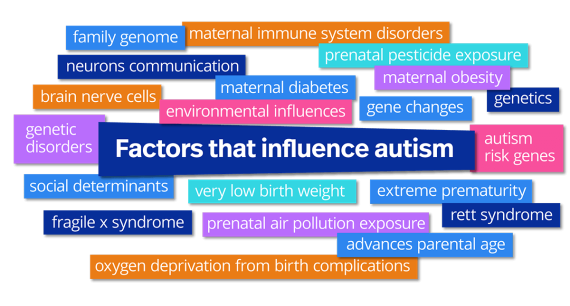
There are many causes of autism. Research suggests that autism spectrum disorder (ASD) develops from a combination of:
- Genetic influences and
- Environmental influences, including social determinants
These factors appear to increase the risk of autism and shape the type of autism that a child will develop. However, it’s important to keep in mind that increased risk is not the same as a cause. For example, some gene changes associated with autism can also be found in people who don’t have the disorder. Similarly, not everyone exposed to an environmental risk factor for autism will develop the disorder. In fact, most will not.
Autism risk factors

Comments are closed