It’s a Non Profit Organaigation & we make Sure to help our underprivillage peaple

Let’s Stay In Touch

Shopping cart

Applied Behavior Analysis (ABA) Research by Sumon Ghosh

  • Home
  • Research
  • Applied Behavior Analysis (ABA) Research by Sumon Ghosh
ABA therapy, which stands for Applied Behavior Analysis, is a type of therapy based on the science of learning and behavior, primarily used to help individuals with autism spectrum disorder (ASD) learn new skills, increase positive behaviors, and decrease problematic behaviors by utilizing positive reinforcement techniques; essentially, it aims to improve communication, social skills, and daily living abilities through structured interventions and rewards for desired actions. Common techniques used in ABA therapy:
  • Discrete trial training (DTT): Breaking down skills into small steps and teaching them one at a time with immediate feedback 
  • Naturalistic teaching: Integrating learning into everyday activities and environments 
  • Picture exchange communication system (PECS): Using pictures to help individuals communicate their needs 
  • Token economy: Earning tokens for desired behaviors which can be exchanged for rewards 
  • Modeling: Demonstrating desired behaviors for the individual to imitate 
    Behavior analysis helps us to understand:
  • How behavior works
  • How behavior is affected by the environment
  • How learning takes place
ABA therapy applies our understanding of how behavior works to real situations. The goal is to increase behaviors that are helpful and decrease behaviors that are harmful or affect learning. ABA therapy programs can help:
  • Increase language and communication skills
  • Improve attention, focus, social skills, memory, and academics 
  • Decrease problem behaviors

Positive reinforcement

  • Positive reinforcement is one of the main strategies used in ABA.
  • When a behavior is followed by something that is valued (a reward), a person is more likely to repeat that behavior. Over time, this encourages positive behavior change.
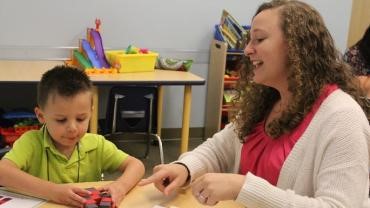
  • First, the therapist identifies a goal behavior. Each time the person uses the behavior or skill successfully, they get a reward. The reward is meaningful to the individual – examples include praise, a toy or book, watching a video, access to playground or other location, and more.
  • Positive rewards encourage the person to continue using the skill. Over time this leads to meaningful behavior change. 
Treatment goals can include many different skill areas, such as:
  • Communication and language
  • Social skills
  • Self-care (such as showering and toileting)
  • Play and leisure
  • Motor skills
  • Learning and academic skills
The instruction plan breaks down each of these skills into small, concrete steps. The therapist teaches each step one by one, from simple (e.g. imitating single sounds) to more complex (e.g. carrying on a conversation). The BCBA and therapists measure progress by collecting data in each therapy session. Data helps them to monitor the person’s progress toward goals on an ongoing basis. The behavior analyst regularly meets with family members and program staff to review information about progress. They can then plan ahead and adjust teaching plans and goals as needed. ABA techniques and philosophy The instructor uses a variety of ABA procedures. Some are directed by the instructor and others are directed by the person with autism. Parents, family members and caregivers receive training so they can support learning and skill practice throughout the day. The person with autism will have many opportunities to learn and practice skills each day. This can happen in both planned and naturally occurring situations. For instance, someone learning to greet others by saying “hello” may get the chance to practice this skill in the classroom with their teacher (planned) and on the playground at recess (naturally occurring). The learner receives an abundance of positive reinforcement for demonstrating useful skills and socially appropriate behaviors. The emphasis is on positive social interactions and enjoyable learning. The learner receives no reinforcement for behaviors that pose harm or prevent learning. When It’s Used ABA is commonly practiced as a therapeutic intervention for individuals with autism. According to the Center for Autism, ABA helps people with autism improve social interactions, learn new skills, and maintain positive behaviors. ABA also helps transfer skills and behavior from one situation to another, controlling situations where negative behaviors arise and minimizing negative behaviors. With autism, ABA is most successful when intensely applied for more than 20 hours a week and prior to the age of 4. ABA can also help aging adults cope with the losses that come with age, like memory, strength, and relationships. For young and old, ABA can help individuals manage some of the lifestyle challenges that accompany many mental and physical health conditions.
logo(acnrc)

Comments are closed